
Last Updated: November 19, 2026
Quick Summary
Remote renovation quality control means managing construction quality on a property you cannot visit, using written standards, scheduled photo and video checkpoints, and recorded sign-offs. Build a signed quality management plan with acceptance criteria, hold points, inspection cadence, and evidence format before work begins, because if it is not written down, it did not happen.
A hold point pauses work for your written approval before it gets covered up.
Concealed work sign-off is the hold point most guides miss and the costliest to skip.
Good evidence needs traceability, completeness, context, and a named written sign-off.
Withhold the release note whenever evidence is incomplete or a hold point is missed.
Structural, gas, and electrical panel work need a licensed inspector or engineer on site.
Renovating from abroad and worried about quality?Studio DKL manages your renovation on site so you can approve every stage from anywhere.Book a Remote Review
Table of Contents
Remote Renovation Quality Control Starts With a Written Quality Management PlanWhat the Plan Must Cover Before Work BeginsConstruction Inspection Checklist for Homeowners: The Hold Points That MatterThe Hold Points That Matter MostA Room-by-Room Remote Hold-Point WorkflowRemote Sign-Off Mechanics at Each Hold PointWhat Requires an In-Person ProfessionalBuild a Remote Property Renovation Communication Plan That Holds Contractors AccountableEvidence Standards for Remote Inspections: What Counts as ProofThe Four Evidence Requirements, Made ConcreteA Capture Protocol the Whole Team Can FollowThe Responsibility MatrixWhen Evidence Is Insufficient: The Failure PlanThe Weekly Evidence CadenceOwner-Side Remote Verification: Sign-Off Without Standing in the RoomIsrael Renovation Management Service Pricing: What You Pay For and What It PreventsWhen Connectivity and Access Fail: A Documentation Backup PlanBook a Remote Project Review Before Your Next Hold PointFrequently Asked Questions
Remote Renovation Quality Control Starts With a Written Quality Management Plan
Remote renovation quality control is the practice of managing construction quality on a property you cannot visit, using written standards, scheduled photo and video checkpoints, and recorded sign-offs.
The most common failure we see is a renovation run on WhatsApp voice notes and good intentions. For the foundational guide to managing an Israeli renovation from abroad, start there before diving into QC specifics.
What the Plan Must Cover Before Work Begins
A quality management plan sets the rules before a single wall comes down. It needs five parts:
Project specifications: plans, drawings, and material schedules, signed by you and the contractor
Acceptance criteria: what “finished” looks like for each trade, in plain terms
Hold points: stages where work stops until you approve
Get this signed into the contract. The Israeli Ministry of Construction and Housing guidance on building standards is a useful reference for the compliance side, and your contractor should be able to show permits and approvals match the plan.
Construction Inspection Checklist for Homeowners: The Hold Points That Matter
A hold point is a stage where work must pause for your approval before it gets covered up. Reviewing from another country requires more than a list of stages: a room-by-room sequence, a named person responsible for evidence at each stop, and a written rule for when evidence does not arrive.
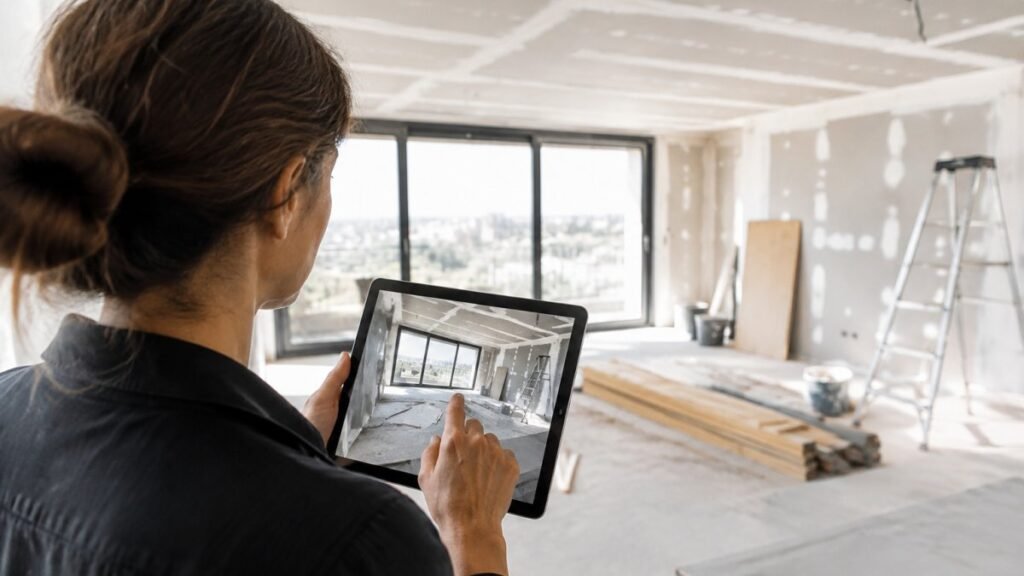
Site manager using a tablet for remote renovation quality control by documenting plumbing before walls are sealed.
The Hold Points That Matter Most
Demolition complete: structure checked, no surprises behind walls, debris cleared, and any exposed structural issues photographed before framing begins.
Rough plumbing and electrical: pipe runs, fall angles, junction boxes, and cable routing photographed and measured before any wall is closed.
Waterproofing in wet rooms: membrane coverage, corner reinforcement, and flood-test results recorded before tiling.
Concealed work sign-off: pipes, wires, vent routing, and cabinet backing photographed with a scale reference and approved in writing before closing.
Tiling and finishes: levels, grout lines, alignment, and substrate preparation checked before and after installation.
Pre-handover inspection: the full punch list walkthrough, with every defect logged, assigned, and dated.
What most guides miss is number four. Once a wall closes, you lose the ability to verify plumbing locations, vent routing, and cabinet backing, and fixing a mistake after closing costs several times more than catching it before. Closing is often rushed because the tiler or drywall crew is already booked, which is exactly when a remote owner needs a hard stop in the contract.
A Room-by-Room Remote Hold-Point Workflow
A single checklist for the whole apartment is hard to audit remotely. Break it down by room and trade, and assign a named person to each capture. A workable sequence for a typical wet room:
Strip-out: wide shot of the room, close-ups of any structural cracks or moisture staining, and a note of what was removed.
First fix plumbing: wide shot showing pipe routes, close-ups of every joint and fall, a tape measure in frame at the soil stack and shower drain, and a short narrated video.
First fix electrical: wide shot of the ceiling and wall chases, close-ups of every back box and cable entry, and a note of circuit labels.
Repeat the pattern for the kitchen, bedrooms, and living areas, adjusting the trades so each room is auditable from a phone screen.
Remote Sign-Off Mechanics at Each Hold Point
A hold point only works if the contractor cannot proceed without a written release. Build three mechanics into the contract:
A pause clause: work at the named stage stops until the owner or the owner’s representative issues a written approval, and the contractor confirms receipt.
A response window: the owner has an agreed number of working days to review the evidence; silence beyond that window does not equal approval unless the contract says so explicitly.
A corrective-action loop: if evidence is incomplete or work is non-compliant, the contractor receives a written defect note with a deadline, and the hold point is re-inspected before release.
Watch out: a contractor who treats the hold point as a courtesy call will close walls first and send photos afterward. Without the pause clause in the signed contract, you have no leverage once the work is concealed.
What Requires an In-Person Professional
Remote review can confirm layout, routing, and finish quality, but some checks need a qualified professional on site. Structural openings, load-bearing changes, gas connections, and electrical panel work should be verified by a licensed inspector or engineer.
These are the stages where work must pause for your written approval before it gets covered up.
Hold point
What gets checked
Demolition complete
Structure checked, debris cleared, exposed issues photographed
Rough plumbing and electrical
Pipe runs, fall angles, junction boxes, cable routing
Waterproofing in wet rooms
Membrane coverage, corner reinforcement, flood-test results
Concealed work sign-off
Pipes, wires, vent routing, cabinet backing with scale reference
Tiling and finishes
Levels, grout lines, alignment, substrate preparation
Pre-handover inspection
Full punch list walkthrough, every defect logged and dated
Build a Remote Property Renovation Communication Plan That Holds Contractors Accountable
A remote property renovation communication plan is a simple weekly rhythm that keeps you informed without micromanaging. Ours looks like this:
Managing Contractors Remotely & Money-Saving Home Renovation Tips
Real Estate Rookie
Weekly video call: same day, same time, with the site manager
Daily photo drop: progress shots in a shared folder
Written decision log: every change, who approved it, and the cost impact
Accountability comes from records, not reminders. When a contractor knows every stage is photographed and logged, workmanship tends to rise on its own. For more, see our playbook on managing contractor accountability.
Evidence Standards for Remote Inspections: What Counts as Proof
Not all photos count as proof. A blurry shot of a wall tells you nothing. Good evidence standards for remote inspections require four things: traceability, completeness, context, and sign-off. What most competitors miss is the operating protocol that makes those four repeatable: who captures, who reviews, how files are named, and what happens when evidence is not good enough.
The Four Evidence Requirements, Made Concrete
Traceability: date, time, and location stamped on every file. Use the device’s native timestamp and a location label in the file name, not a handwritten note added later.
Completeness: a wide shot plus close-ups. A wide shot proves the room; a close-up proves the detail; you need both to confirm they belong together.
Context: a tape measure or reference object in frame for dimensions. A coin, a tile, or a printed scale card works; a bare wall does not.
A useful rule: if a photo could have been taken in any apartment, it is not evidence. It has to show your apartment, at a specific stage, with something proving scale.
A Capture Protocol the Whole Team Can Follow
A protocol is what turns good intentions into usable records. Agree these five rules before the first hold point:
File naming: room, trade, hold point, and date in a fixed pattern, for example wet-room_plumbing_first-fix_2026-11-19_01.jpg, so a shared folder stays searchable months later.
Photo angles: one wide shot from the doorway, one from the opposite corner, and close-ups of every joint, junction, and connection. For concealed work, add a shot with the tape measure touching the item.
Video walkthroughs: a single unedited clip per hold point, narrated by the camera holder, starting at the door and ending at the furthest detail. No cuts, because cuts break the chain of evidence.
The Responsibility Matrix
Remote quality control fails when everyone assumes someone else is capturing the evidence. Write a simple matrix into the plan:
Site manager or contractor: captures photos and video at each hold point, uploads within an agreed window, and flags any stage that cannot be captured.
Independent inspector or owner’s representative: reviews the upload against the specification, requests re-shoots where evidence is insufficient, and issues the written release.
Owner: reviews the summary and release note, approves or escalates, and keeps the archive.
A common pattern is that the site manager captures well for the first two weeks and then drifts back to voice notes. The matrix only holds if the release note is withheld when evidence is incomplete.
When Evidence Is Insufficient: The Failure Plan
Evidence will fail at some point. The plan should say what happens next, not leave it to a phone call.
Missed hold point: if work proceeds without the agreed evidence, the contractor must reopen or expose the work for inspection at their cost, or the payment milestone is held.
Incomplete upload: the reviewer issues a re-shoot request with a deadline; the hold point stays closed until it arrives.
Poor connectivity: the site manager uses the offline checklist and a phone backup, uploads when connectivity returns, and notifies the reviewer so the hold point is not released on partial evidence.
Watch out: releasing a hold point on a promise that photos will follow is the most common way remote owners lose their verification window. Once the wall is closed, the promise is worthless.
The Weekly Evidence Cadence
Set a rhythm so evidence does not pile up: daily photo drops for active rooms, a weekly video walkthrough of the whole site, and a weekly archive export. At each hold point, the reviewer checks file naming, angles, scale references, and the sign-off note before issuing a release. That cadence separates a folder of pictures from an inspection record you can rely on in a dispute.
Owner-Side Remote Verification: Sign-Off Without Standing in the Room
You can approve work without being on site, but only if someone you trust is your eyes. Owner-side remote verification means combining three streams:
Contractor documentation: photos and videos at each hold point
Independent inspection: a third party who visits and confirms the work matches the plan
Your review: a short video call to walk through the evidence before you sign
Studio DKL offers full-service management from concept to completion, including for clients managing projects from abroad. For the full playbook, read how to renovate your apartment remotely.
Israel Renovation Management Service Pricing: What You Pay For and What It Prevents
Pricing depends on project scope and the coordination the project needs. For current prices or a quote, please visit the Studio DKL website.
Coordinated renovation management aims to reduce costly rework, such as a misrouted vent or a wrong cabinet depth.
For a full breakdown of what drives cost, read our guide to renovation management pricing.
When Connectivity and Access Fail: A Documentation Backup Plan
The internet drops. A site manager is unavailable. A key holder is on holiday. A documentation backup plan keeps the project moving when the tech does not cooperate.
Build these into the plan from day one:
Two capture methods: tablet photos plus a phone backup, saved to cloud and a local drive
Offline checklist: a printable version of every hold point so nothing is skipped
Backup contact: a second person on site authorized to photograph and report
The goal: no hold point should ever be missed because of a dead battery or a locked door.
Book a Remote Project Review Before Your Next Hold Point
Renovation quality is decided before the first tile is laid, not after.
Get started with Studio DKL and protect your renovation from costly rework, wherever you are. Contact us to book a remote project review before your next hold point.
Managing a renovation from abroad works best when you have a clear plan, a firm hold-point schedule, and someone on the ground checking the work.
Frequently Asked QuestionsHow can I monitor construction quality if I am not in the country?Set up a written remote renovation quality control plan before work starts. It should name every hold point, the photos and video required at each one, and who signs off. You approve each stage from your phone or laptop before the contractor covers any work.What are the essential inspection milestones for a home renovation?The milestones that matter most are the ones before work gets hidden. Check plumbing locations, vent routing, electrical rough-in and waterproofing before tiling or wall closing. Then check cabinet backing, appliance requirements and wet-area slopes before installation. Finally, run a pre-handover inspection covering finishes, seals and function. Each milestone needs dated photos, a short video walkthrough and a signed acceptance note before the next trade starts.How do I handle quality disputes with contractors from abroad?Disputes are easier when the contract sets out acceptance criteria and evidence standards in advance. Keep every photo, video and written approval in one shared folder with dates. When a defect appears, send a written notice that names the defect, the specification it breaches and the corrective action required, with a deadline. If the contractor disagrees, refer to the signed inspection records. A local representative can also attend the site to verify the defect in person.
Add studio-dkl.com as a preferred source on Google →